

Smokescreen or True Transformation?
Lucas Gage says he is abandoning antisemitism. His own words suggest something very different


Many are now wondering why the Jewish community is rather skeptical about the image of a “repentant” Lucas Gage. Perhaps it is worth clarifying that, in essence, there was no “repentance” at all. He adjusted his course in favor of a position more convenient for himself, which some rushed to interpret as a miraculous transformation. But haste is only useful when catching fleas. Despite the loud title of his Substack article, Abandoning “Antisemitism.”, he immediately makes it clear that he is not apologizing and is not renouncing his previous beliefs. If most people did not go beyond the loud headline, then it becomes clear why the public was misled. Let his own words speak for themselves.
I have decided to officially abandon antisemitism. This is not an apology; this is a self-correction.
So how does self-correction differ from an apology? In essence, it is a way to save face, to tell everyone that he is not perfect, while at the same time leaving the door to the past open. Ultimately, he merely admits that his previous activity was unproductive and is ready to continue in the same direction, only now using a different strategy.
I do not denounce my beliefs about Jewish supremacy and criminality in certain areas of society nor Jewish overrepresentation, which are all well substantiated. These are legitimate issues that must be addressed, but done so in an effective manner, without LARPs, fantasies, and emotionally driven, obsessive antisemitism that looks at all Jews the same way.
Does it even need to be explained that he is not renouncing his beliefs, when he says so directly? He does not even try to present this as something new, since he immediately lists the main antisemitic conspiracy talking points, led by “Jewish supremacy,” and then tries to legitimize old accusations as “real problems.” He does not hide the fact that he intends to continue in the same spirit, but will choose a less aggressive tactic for doing so. Perhaps Jews are supposed to feel relieved and reassured by that?
I am not abandoning any of my principles, which have always been based on sovereignty. I maintain that it is best for all groups to have sovereign living spaces and not be ruled by outgroups.
He does not forget to repeat that his worldview has not changed, and then moves toward ethnonationalist separation. In essence, this comes down to the idea that states or territories should be divided along ethnic lines — a premise that leads to deeply troubling conclusions. The main question is how he intends to achieve this.
I do regret some of my actions, not because they were “wrong” but because they were ultimately ineffective.
And what do we see? He regrets not his actions, but the fact that his methods did not work. Everything comes down only to cold calculation and effectiveness. Now that he has failed to achieve satisfactory results, it is time for a new approach.
It is quite obvious that Lucas Gage has not changed his views and has not moved to the opposite camp, however much some may wish that were the case. He has remained faithful to his principles, and his past only confirms his present. He cannot be called a random figure in anti-Zionist circles, since for many years he played a visible role in the white nationalist movement, and in 2015 he served as chairman of the National Youth Front — an extremist organization.
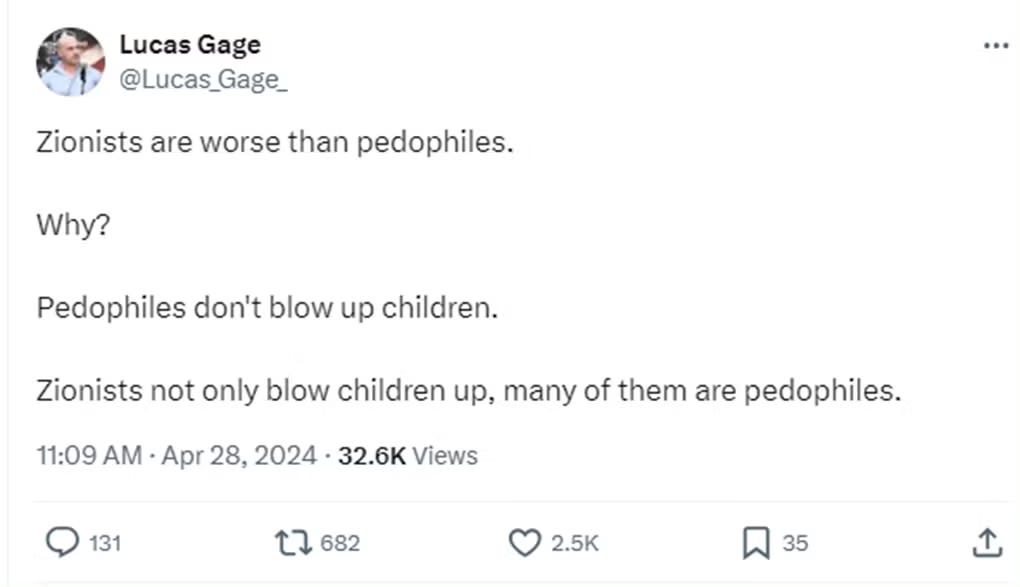
His public statements were openly antisemitic and left no room for any other interpretation.

Further examples:
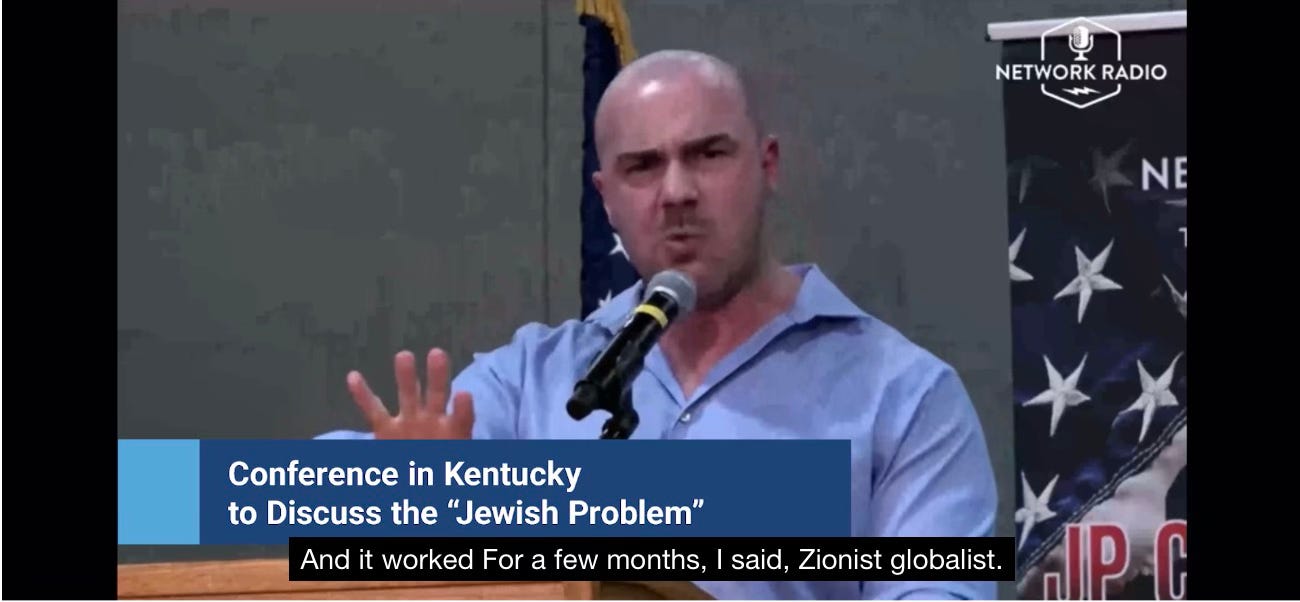
On June 30, 2024, the “Jewish Problem” conference was held in Somerset, Kentucky, bringing together many like-minded people, with Lucas Gage among the speakers. Is it even necessary to mention what kinds of “problems” were discussed there, and with what passion its participants spoke?
What is happening now? In reality, there is no particular difference. Gage’s departure from the “movement” only indicates that he has found a different concept for continuing the old cause. One can hide behind loud statements as much as one likes, but good faith in this case requires proof in the form of concrete steps — public statements condemning antisemitism in any form. Yet his article Abandoning “Antisemitism.” looks utterly removed from the intentions being attributed to him and exposes any attempt to interpret them otherwise.
It is not difficult to understand why many refuse to believe someone who spent years speaking against Israel, Zionists, and built his name on it. One may assume that his former audience, or disagreements with his associates, no longer satisfied him due to diminishing returns, and that he found a way to regain interest in himself while remaining faithful to his ideals — ideals that, in fact, run counter to the values professed by the Jewish community.